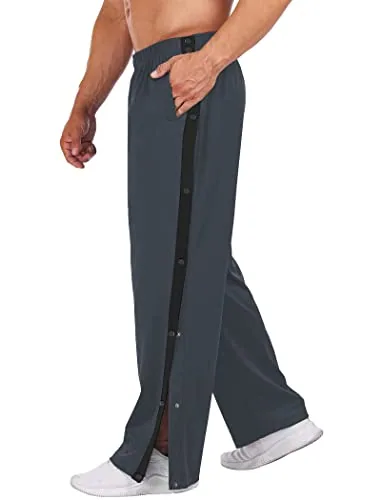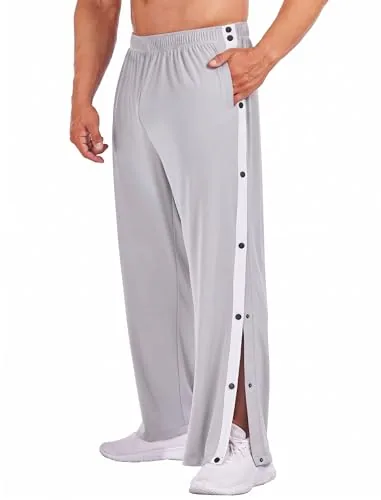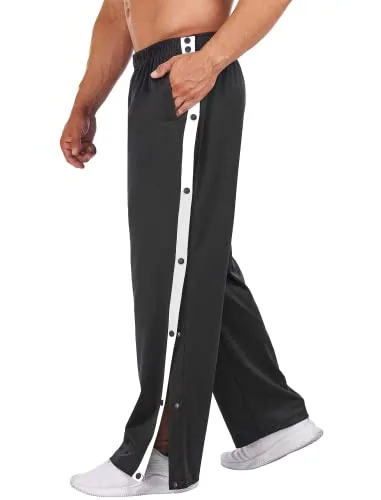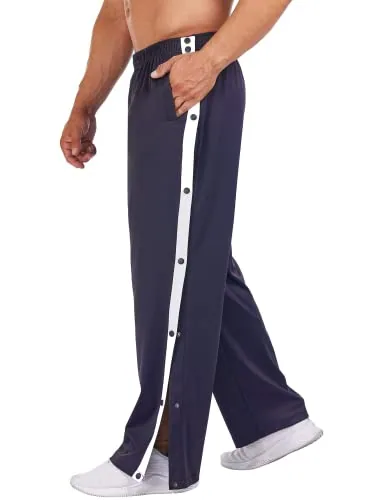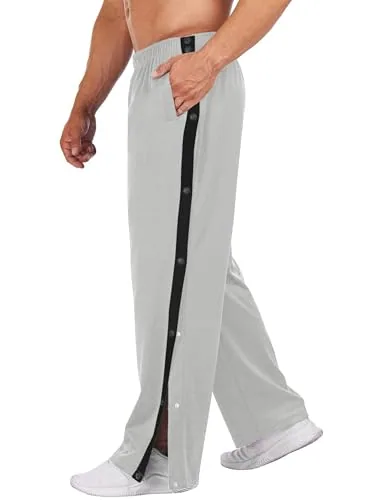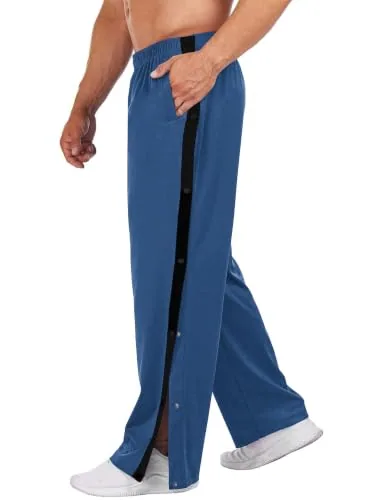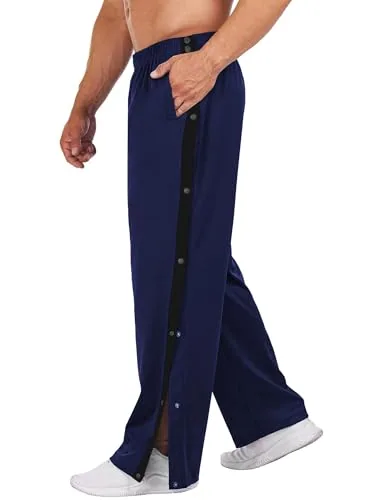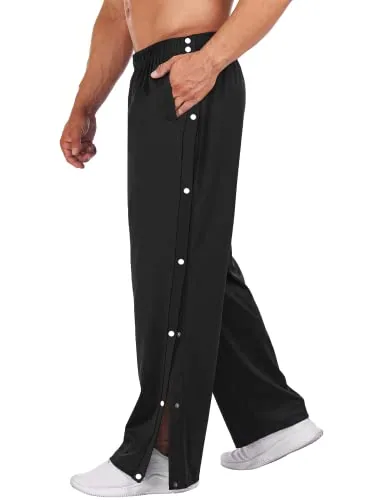
Men's Tear-Away Pants, Pure Black GP
4.4 out of 5 from 1,828 ratings
$31.99
See how it opensQuality
A garment that opens along a seam of snaps has more to go wrong than a T-shirt, and more to check before you buy. Here is how the pieces are put together, what fails first, what the federal care rule obliges the label to say, and the washing routine that keeps a snap seam closing for a second year.
11 minute read · sources read 5 September 2026
4.4 out of 5 from 1,828 ratings
$31.99
See how it opens4.4 out of 5 from 1,828 ratings
$31.99
See how it opens4.4 out of 5 from 1,828 ratings
$26.99
See how it opens4.4 out of 5 from 1,828 ratings
$31.99
In a T-shirt, quality is the fabric and the neck. In a piece that opens on snaps, quality is the seam that opens. How the tape holds the snaps, how far apart they sit, whether the seam lies flat when closed, and whether it survives two openings a day for a season. Everything on this page follows from that, and it is the first thing the people behind Deyeek look at when a sample comes in.
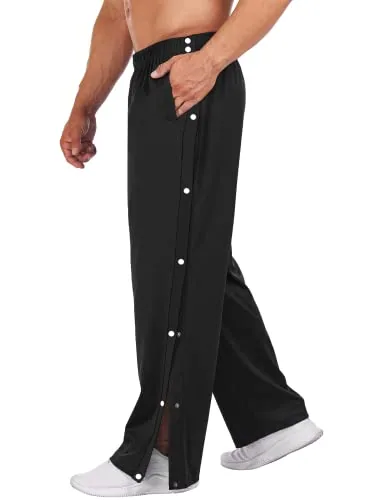
The snaps in the range sit in a woven tape, and the tape runs along the seam inside the garment. That matters for two reasons. A snap pressed straight into knit fabric pulls a hole in it within weeks. A snap in tape spreads the load along the whole seam. And the tape decides the spacing, so every snap on a piece sits at the same interval, close enough that the seam does not gape and far enough apart that one hand can find the next one.
The studio makes two checks on every sample. Two stitch lines hold the tape, not one. And the first and last snaps sit within a finger of the ends of the seam, because the seam at the hem is the one you close in a hurry.
The placket that hides a snap seam covers the studs when closed and no more, so the seam does not read as a stripe. Where a piece has a chest opening for a port, a facing on the inside keeps the zip or the snaps off the skin.
Drain pockets on the mastectomy tops hang as a separate bag inside the garment, deep enough for the bulb. The stitching at the top carries the weight, so the bulb does not drag the front of the top down.
Ordinary pockets, on the pants and the sweatpants, are bagged and bar-tacked at the corners. It is the same construction as any decent pair of sweatpants. Nothing about an adaptive piece asks for less.
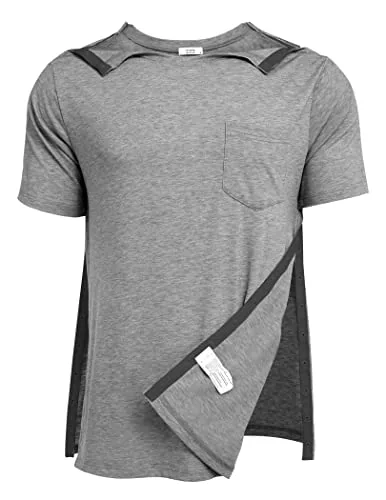
A piece that is opened twice a day wears in a few predictable places. Knowing them means most of the failures can be prevented, and the rest can be fixed for pennies.
| What you notice | Usual cause | What helps |
|---|---|---|
| Snap tape pulling away at the hem | the seam is closed under tension every day | take the size up over a dressing, close from the hem, not the collar |
| A single snap that no longer holds | grit in the stud, or a bent socket | rinse the stud, press closed on a flat surface, do not force |
| Hook and loop that catches the fabric | washed open | close every strip before the wash |
| Pilling on the inside of a blend | friction with a dressing or a sling | wash inside out, cool, it is cosmetic |
| Elastic waist that stays stretched | hot dryer | low heat or line dry |
| Cotton shorts a size smaller | hot wash | cool water, they will not come back |
The first row is the one to remember. A snap seam closed under tension, over a dressing the size did not allow for, is a seam that pulls away at the hem within a month. The size page says it plainly: over a sling or a dressing, take the size up.
A care label is a regulated statement, not a suggestion. The federal rule starts with where the label has to be.
Manufacturers and importers must attach care labels so that they can be seen or easily found when the product is offered for sale to consumers.
16 CFR 423.6(a), Textile wearing apparel, read 5 September 2026
And then with what it has to say.
Care labels must state what regular care is needed for the ordinary use of the product.
16 CFR 423.6(b), Textile wearing apparel, read 5 September 2026
Regular care for ordinary use: the routine, not the rescue. For a piece that will be washed often, it is the sentence that decides your week. Where the maker's description states a wash instruction, our page prints it. Where it does not, the label sewn into the garment is the authority, and the counts below say how often the description carries it.
Assume the label allows a machine wash. The rest is technique, and all of it protects the seam.
Heat and time. A hot dryer shrinks cotton, relaxes elastic, matures spandex and can deform a plastic snap. A garment left damp in a machine for a day smells and, on a blend, marks the inside. Low heat or a line, and out of the machine the same hour: that is the whole rule.
Where a label permits tumble drying it will name the setting, and the setting is not a formality. A snap seam dried hot closes a little less crisply every month until one day it does not.
Counted from the catalogue at the last update: how many pages in each bench carry a snap seam, hook and loop or magnets, and how many carry a washing instruction in the maker's description.
| Bench | Pages | Snap seam | Hook and loop | Magnets | Washing stated |
|---|---|---|---|---|---|
| Post-Surgery Shirts | 369 | 346 | 67 | 14 | 182 |
| Chemo Port & Dialysis Shirts | 275 | 155 | 3 | 12 | 118 |
| Hospital Gowns & Open-Back Dresses | 123 | 87 | 0 | 0 | 64 |
| Adaptive Tear-Away Pants | 196 | 196 | 31 | 0 | 31 |
| Sweatpants & Joggers | 47 | 10 | 1 | 0 | 27 |
| Pajama & Lounge Shorts | 17 | 0 | 0 | 0 | 6 |
| Long-Sleeve Polos | 26 | 0 | 0 | 0 | 0 |
4.4 out of 5 from 1,828 ratings
$31.99
See how it opens4.4 out of 5 from 1,828 ratings
$31.99
See how it opens4.4 out of 5 from 1,828 ratings
$26.99
See how it opens4.4 out of 5 from 1,828 ratings
$31.99
Every new piece is tried in the Deyeek studio before it goes on a page, and the checks are the same each time.
None of that is a laboratory, and none of it is a certificate. It is a room, a bed, a pair of hands and a rule about what goes on the page.
4.4 out of 5 from 1,828 ratings
$31.99
See how it opens4.4 out of 5 from 1,828 ratings
$31.99
See how it opens4.4 out of 5 from 1,828 ratings
$31.99
4.4 out of 5 from 1,828 ratings
$31.99
See how it opens